Citizen Participation in Tourism Governance
How to: democratise the visitor economy

Citizen Participation in Tourism Governance
How to: democratise the visitor economy
How to: democratise the visitor economy
How to: democratise the visitor economy
Tourism is no longer judged solely by how many visitors arrive or how much they spend. Today, it is judged by how it affects the people who live in the destination. Time for DMOcracy white paper by Group NAO examines what that shift means for destination governance and how destination organisations can shape the future of tourism on local terms.
Tourism under pressure
Travel and tourism have gone through a highly disruptive decade. The global visitor economy has become increasingly politicised, with cities struggling to balance liveability and visitability, and decisions affecting housing, mobility, public space, and everyday life are made too often without meaningful citizen involvement. In this ‘hard-mode’ environment, DMOs are at risk of losing support and license to operate from all sides. On this backdrop, the white paper poses a fundamental question:
How can DMOs become a legitimate, trusted part of the conversation with the local community on the (better) future of tourism?
State and spectrum of participation today
Drawing on the International Association for Public Participation’s Spectrum of Public Participation, the white paper first adapts the model to destination governance and outlines five distinct approaches: informing, consulting, involving, collaborating, and empowering. Each comes with different expectations of influence and ownership.
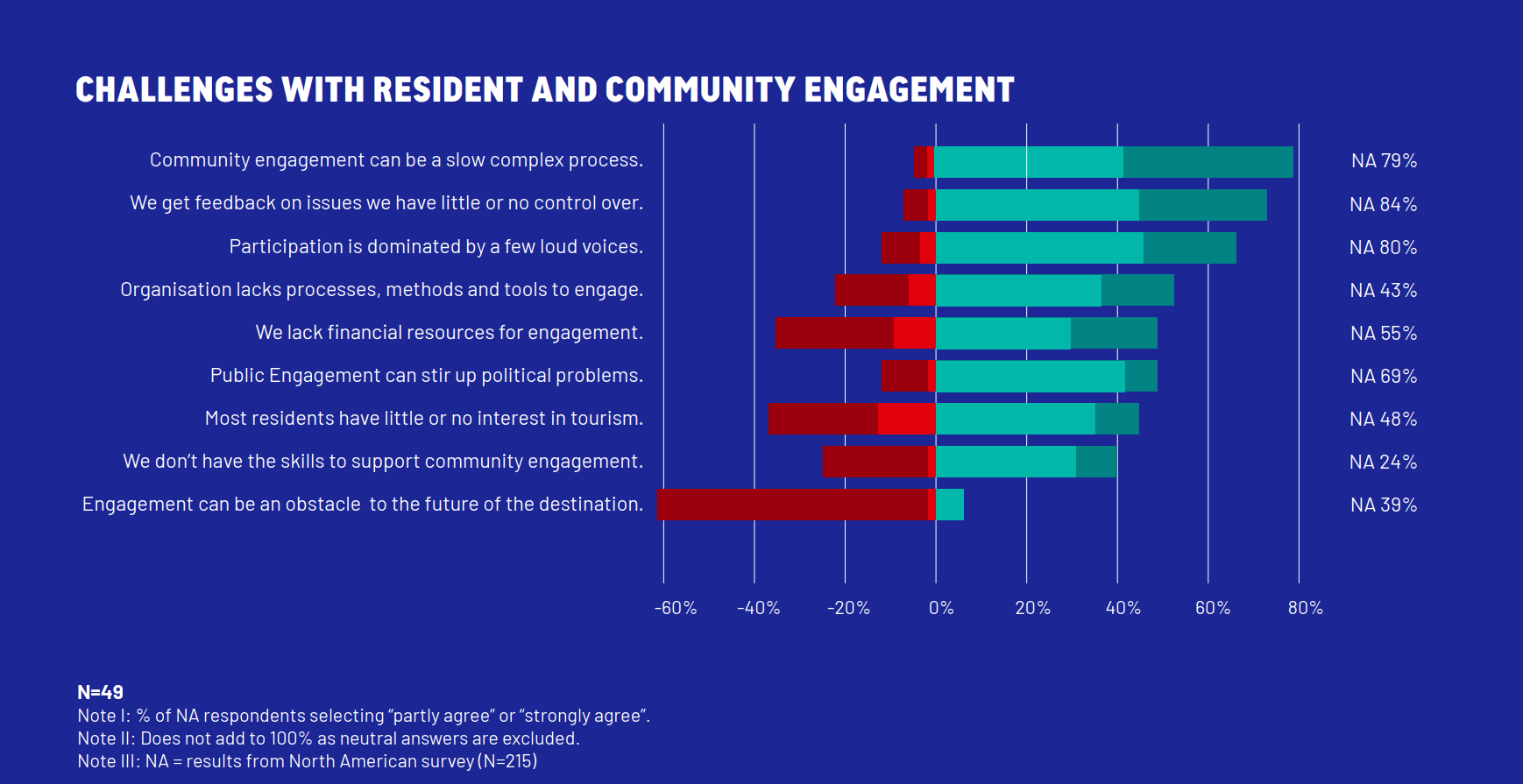
To understand how destination organisations are working with citizens today, Group NAO and Miles Partnership conducted a transatlantic survey of DMOs in Europe and North America. The findings paint a mixed picture.
Resident engagement is widely recognised as essential to sustainable tourism. Surveys measuring resident sentiment are becoming more common, particularly in Europe. Advisory boards, volunteering programmes, and communication initiatives aimed at residents are also widespread.
At the same time, meaningful participation remains difficult. Many DMOs cite a limited mandate, a lack of control over broader policy issues, and the risk that engagement will be dominated by a small number of vocal groups. Industry stakeholders continue to play a central role, often more consistently than citizens themselves.
The challenge is not to promise more democracy than can be delivered, but to design participation that is honest and functional.
Eight approaches in practice
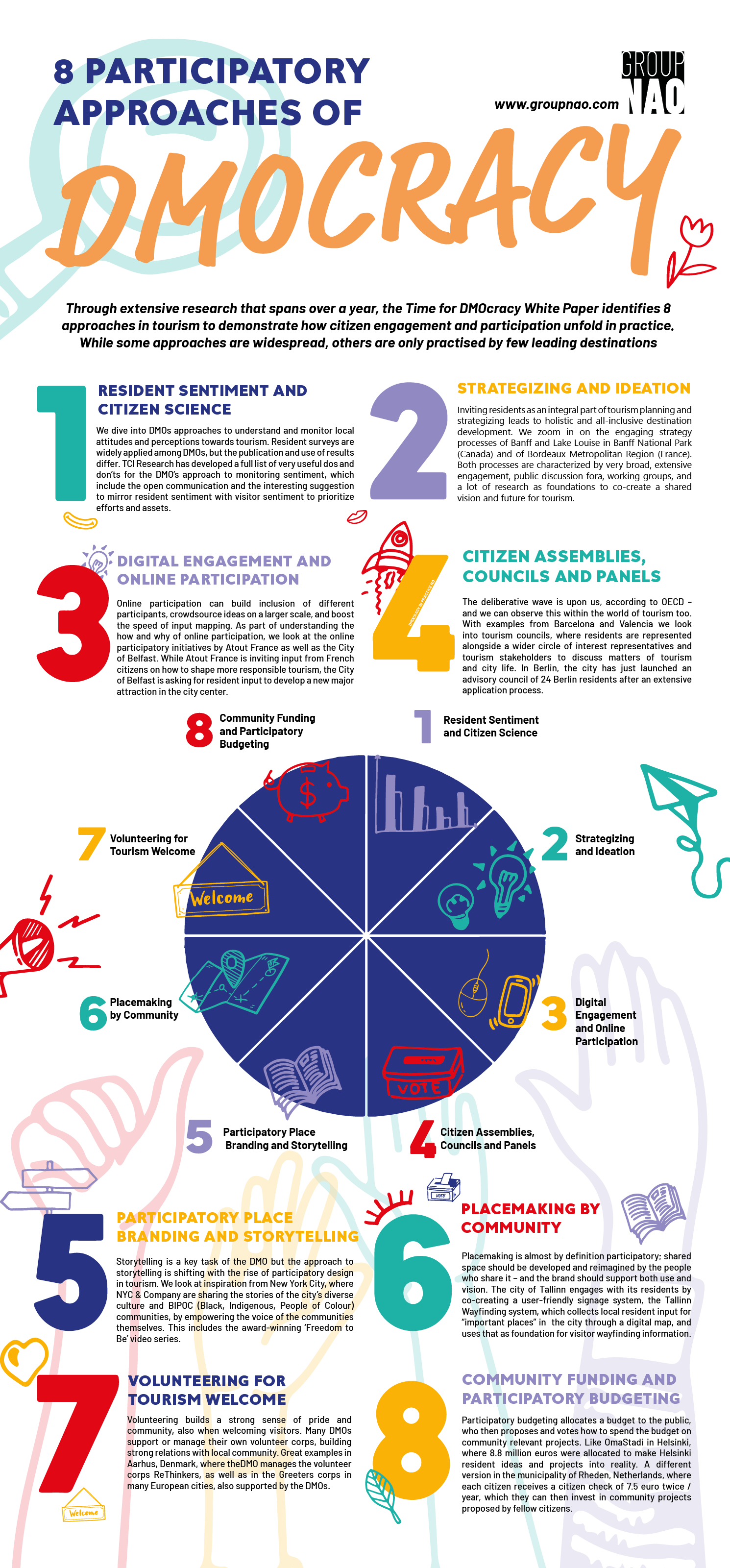
Building on interviews, case studies, learning labs, and a year-long research process, Time for DMOcracy identifies eight participatory approaches for destinations to connect with their communities. Some are already widespread, others less so. Together, they illustrate the diverse forms citizen engagement can take, from community funding to participatory place branding and storytelling.
Crucially, the DMO role is fluid and contextual. The relevance of a destination organisation depends on ongoing, open dialogue with the wider destination ecosystem and a shared understanding of needs, limits, and responsibilities. And that’s why it’s…
Time for DMOcracy!
Time for DMOcracy does not offer one fix-all role for destination organisations. Instead, it charts a path forward for DMOcracy as a new social contract between destination and community, as a destination mindset, and as a framework for destination governance. It sets the stage for destination governance, which creates value not for tourism as an isolated goal or agenda, but for the destination ecosystem of both community AND visitor economy.
To dive into creating a more democratic visitor economy and embracing public participation in destination governance (or just getting some juicy insights on what happens when democracy meets tourism).
Download the Time for DMOcracy white paper here:
Visit project website